
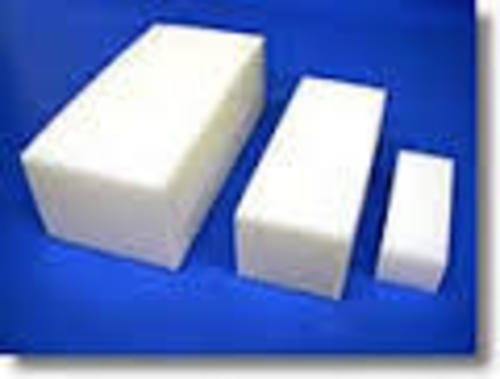
PTFE Blocks
Product Details:
- Heat Resistance Yes
- Density 2.3 Gram per cubic centimeter(g/cm3)
- Plastic Type Thermoplastic
- UV Resistant Yes
- Surface Finish Smooth
- Tensile Strength 21 - 26 MPa
- Melting Point 327°C
- Click to View more
X
PTFE Blocks Product Specifications
- 2.3 Gram per cubic centimeter(g/cm3)
- Yes
- PTFE (Polytetrafluoroethylene)
- Variable (depends on size)
- Thermoplastic
- PTFE Block
- Yes
- Smooth
- White
- Custom/Standard
- Custom/Standard (as per requirement)
- Compression Molding
- 21 - 26 MPa
- 327°C
- Yes
- 60-65 Shore D
- Molding
- Solid
- Easy to machine
- -200C to +260C
- Yes
- 0.25 W/mK
- Gaskets, Seals, Insulation, Chemical Processing
- Negligible
- Superior
- 0.04
- Non-flammable
- Excellent
Product Description
PTFE blocks are solid blocks made from Polytetrafluoroethylene (PTFE), a high-performance fluoropolymer known for its outstanding non-stick, chemical resistance, and high-temperature properties. PTFE blocks are utilized in various industrial applications, including seals, gaskets, bearings, and insulators, where a robust, chemically inert, and low-friction material is required. These blocks offer excellent electrical insulation, low dielectric constant, and wide temperature tolerance, making them a reliable choice for demanding engineering and manufacturing applications.
FAQs:
Q: What are PTFE blocks?
A: PTFE blocks are solid blocks made from Polytetrafluoroethylene (PTFE), a fluoropolymer with exceptional non-stick and chemical-resistant properties.
Q: What are the main properties of PTFE blocks?
A: PTFE blocks are known for their non-stick nature, chemical inertness, high-temperature resistance, excellent electrical insulation, and low dielectric constant.
Q: Where are PTFE blocks used?
A: PTFE blocks find uses in various industrial applications, including seals, gaskets, bearings, insulators, and other components requiring chemical resistance and low friction.
Q: What are the advantages of using PTFE blocks?
A: The advantages of using PTFE blocks include their non-stick properties, resistance to chemicals and solvents, low friction, high dielectric strength, and wide temperature range.
Superior Chemical Resistance and Versatility
PTFE Blocks withstand aggressive chemicals, rendering them invaluable in industrial and chemical processing environments. Their low friction, negligible water absorption, and high heat resistance ensure prolonged durability and consistent performance, whether used as seals, gaskets, or insulation. Compatible with a variety of configurations and applications, these blocks are tailored to both standard and custom requirements for optimal utility.
Safe and Reliable for Critical Applications
Approved by FDA and featuring excellent electrical insulation and outstanding flame retardancy, PTFE Blocks are extensively used in food processing, electrical, and thermal insulation applications. Their smooth finish, solid white color, and leak protection qualities further enhance safety and efficiency. With a hardness of 60-65 Shore D and a robust tensile strength, they remain reliable even under extreme conditions.
FAQs of PTFE Blocks:
Q: How are PTFE Blocks manufactured and customized?
A: PTFE Blocks are produced using the compression molding process, allowing flexibility in both standard and custom sizes depending on a clients requirements. This technique ensures a dense, uniform product that can be easily machined to precise dimensions, resulting in high accuracy and smooth surface finishes.Q: What are the main advantages of using PTFE Blocks in industrial settings?
A: The primary benefits include superior chemical resistance, negligible water absorption, excellent electrical and thermal insulation, non-flammability, and remarkable heat resistance. Their easy machinability and FDA approval make them exceptionally suitable for diverse environments, from chemical plants to food processing industries.Q: When should I choose PTFE Blocks over other plastic materials?
A: PTFE Blocks are ideal when your application demands resistance to aggressive chemicals, extreme temperatures (ranging from -200C to +260C), excellent electrical insulation, and a non-stick, low-friction surface. Their solid, non-flammable nature and leak protection are crucial where high reliability and safety are required.Q: Where are PTFE Blocks commonly used?
A: These blocks are widely utilized in gaskets, seals, electrical insulation, and chemical processing equipment. Industries including pharmaceuticals, food processing, electronics, and chemical manufacturing benefit greatly from the unique properties of PTFE Blocks.Q: What is the process for ordering custom PTFE Block sizes?
A: To obtain custom sizes, you can provide detailed specificationssuch as preferred dimensions, weight, and application requirementsto the manufacturer, distributor, or supplier. After reviewing your specifications, a tailored compression molding and machining process is used to deliver blocks that match your criteria precisely.Tell us about your requirement

Price:
Quantity
Select Unit
- 50
- 100
- 200
- 250
- 500
- 1000+
Additional detail
Mobile number
Email

Other Products in 'PTFE (POLYTETRAFLOUROETHYLENE)' category



CONTACT US

- 10 & 11, Sarang Industrial Estate, Ground Floor, Near Municipal Garden, Navghar, Vasai(E), Palghar,Vasai - 401208, Maharashtra, India
- Phone : 08045815843
CASILON POLYMERS PVT. LTD.
GST : 27AAACC4899E1ZH

- Mr Jayraj Manoti (Director)
- Mobile : 08045815843
- Mobile : 08045815843
-
 Send Inquiry
 Send Inquiry
CATEGORIES
 Send Inquiry
 Send SMS
CASILON POLYMERS PVT. LTD.
All Rights Reserved.(Terms of Use)
Developed and Managed by Infocom Network Private Limited.
Developed and Managed by Infocom Network Private Limited.
